Timing Belts for Packaging Machinery: A Complete Application Guide for OEMs
Timing Belts for Packaging Machinery: A Complete Application Guide for OEMs
Where synchronous drives earn their place on sealing, wrapping, cartoning and pouch lines
No industry punishes a sloppy drive like packaging. Lines run at hundreds of cycles per minute, stations must stay phase-locked to the film or the carton, and a single skipped tooth turns a shift of production into scrap film and jammed product. That is why packaging machine timing belts do far more than transmit power on modern equipment: they position, carry, grip and index product itself. This guide maps the applications an OEM needs to cover, explains the material choices behind a true food grade timing belt, and shows what to demand from a timing belt supplier when downtime is measured in thousands of dollars per hour.
Why Packaging Machines Depend on Precision Timing Belt Drives
A packaging line is a choreography problem. Film feed, sealing jaws, cutting heads, date coders and outfeed conveyors must all hold a fixed phase relationship, cycle after cycle. Chains stretch and accumulate error; friction drives slip exactly when the load peaks. Synchronous belts hold their phase because the teeth lock into the pulley — no slip, no creep, minimal maintenance. For an OEM, that means:
- Registration accuracy. Print-to-cut and seal-to-fill registration depend on backlash-free, stretch-limited drives; timing belts with glass or Kevlar cords keep tolerance over millions of cycles.
- Clean, dry operation. No chain oil near product — a decisive advantage wherever food, pharma or electronics are packed.
- Quiet, high-speed running. Curvilinear profiles (HTD, GT) mesh smoothly at the speeds horizontal flow wrappers and cartoners demand.
- Compact drives. Small pulleys and thin belts fit the dense machine layouts of modern packaging equipment.
Where the same belt also touches product, it becomes a timing belt conveyor — a positioning element with the transmission reliability of a drive belt built in.
Timing Belt Applications in Sealing, Wrapping, Cartoning and Pouch Lines
Across machine types, the same handful of application patterns repeats. Knowing which pattern your station falls into makes the belt specification almost automatic:
| Machine type | Timing belt role | Typical specification |
|---|---|---|
| Flow wrappers (HFFS) | Film transport and product infeed pushers | Rubber coated timing belt, high friction surface, custom cleats |
| VFFS pouch machines | Bag transport and sealing-jaw sync | Food grade PU or silicone backing, oil and heat resistance |
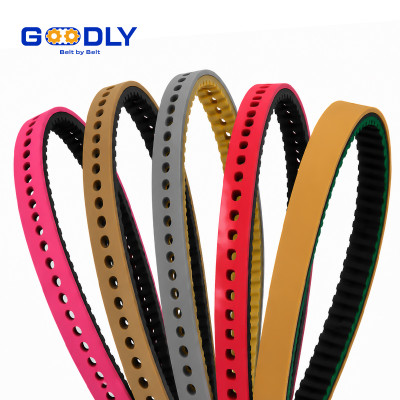
| Cartoning machines | Carton conveying and flap tucking | Sponge or rubber backing, vacuum holes, precise indexing |
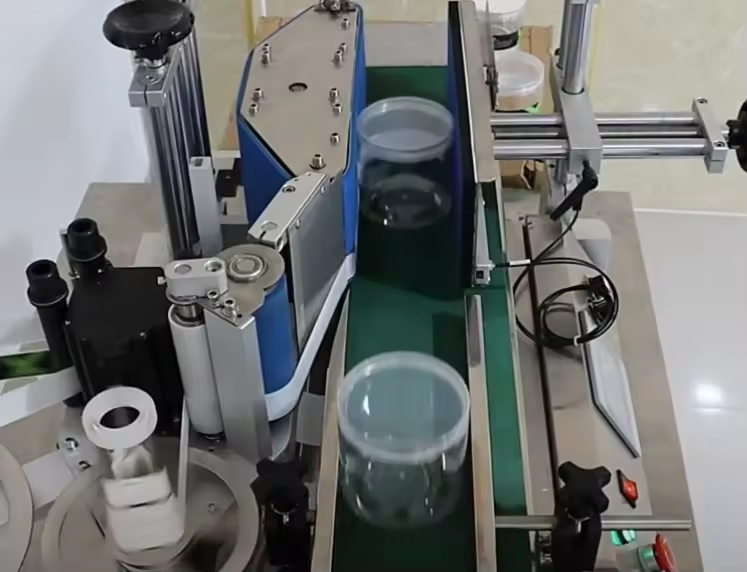
| Labelling machines | Container spacing and wrap stations | Open-ended or spliced belts, precise pitch, abrasion-resistant face |
| Case packers / palletizers | Product accumulation and transfer | Wide timing belt conveyor sections, high-tension cords |
In every pattern, the deciding question is the same: does the belt touch product? If yes, the backing material and its certifications dominate the spec; if no, a standard industrial timing belt in the correct profile does the job economically — our timing belt range covers the drive-only cases.
Custom Timing Belts for Chocolate Wrapping and Coffee Pouch Sealing
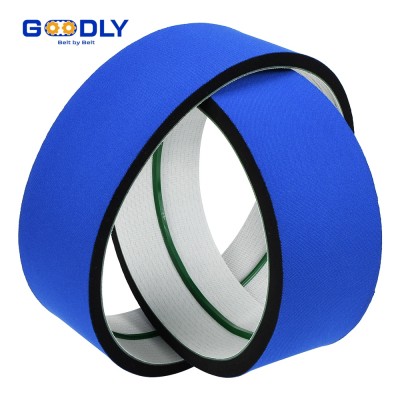
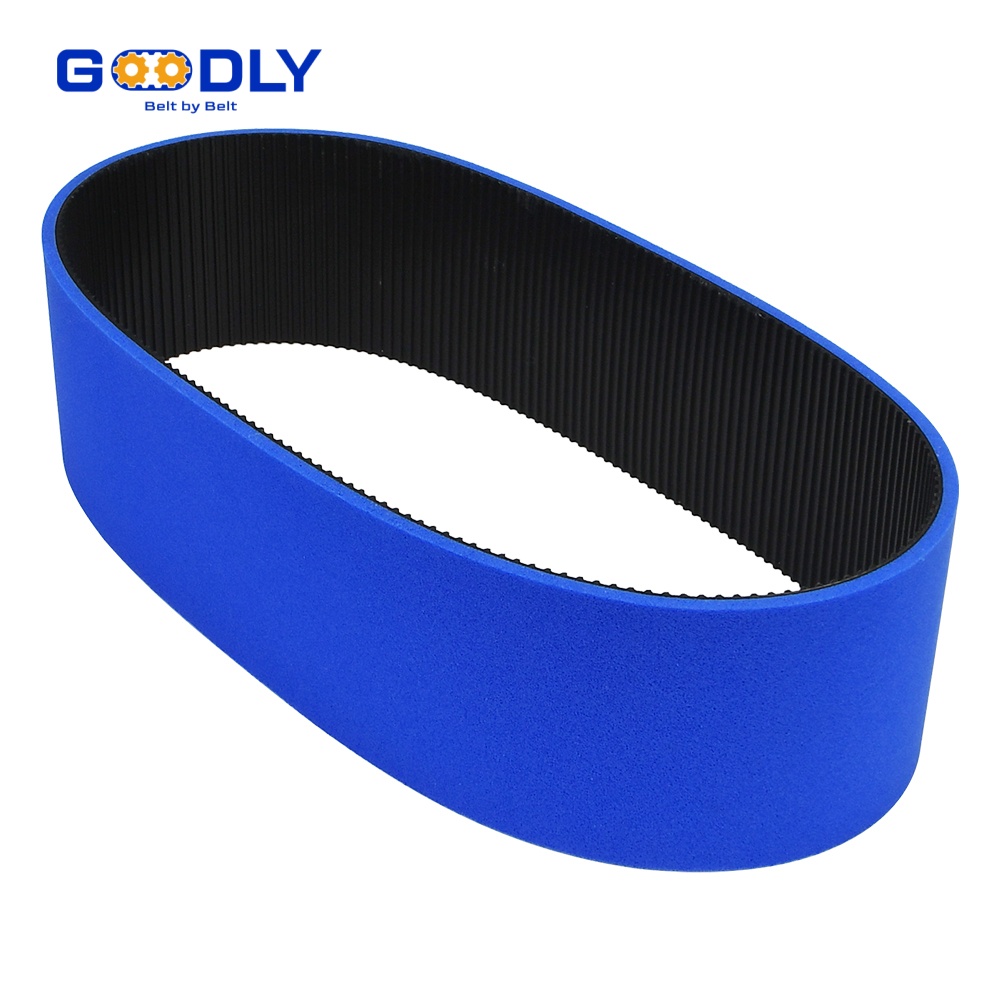
Two classic examples show why OEMs end up ordering custom timing belts rather than catalog parts. In chocolate wrapping machines, twist-wrap and fold-wrap stations grip delicate foil-wrapped product with rubber-coated belts; the coating hardness, surface texture and cleat pattern all change how the twist forms, so the belt is literally part of the recipe. In coffee pouch sealing, belts run close to hot sealing jaws: they need silicone or high-temperature rubber backings that resist both the heat and the oils in ground coffee, with food-contact compliance. Both applications ship as custom loops — specific pitch length, backing compound, thickness and machining — and both fail early when someone substitutes a generic belt. See our rubber coated timing belt options and the custom specification guide in custom timing belts for how to define them.
Choosing Timing Belt Materials for Food-Grade Packaging Equipment
A credible food grade timing belt is specified from the outside in: backing compound first, then carcass, then tooth material. The comparison below reflects what we mould daily for packaging OEMs:
| Backing / material | Temperature | Strengths | Typical use |
|---|---|---|---|
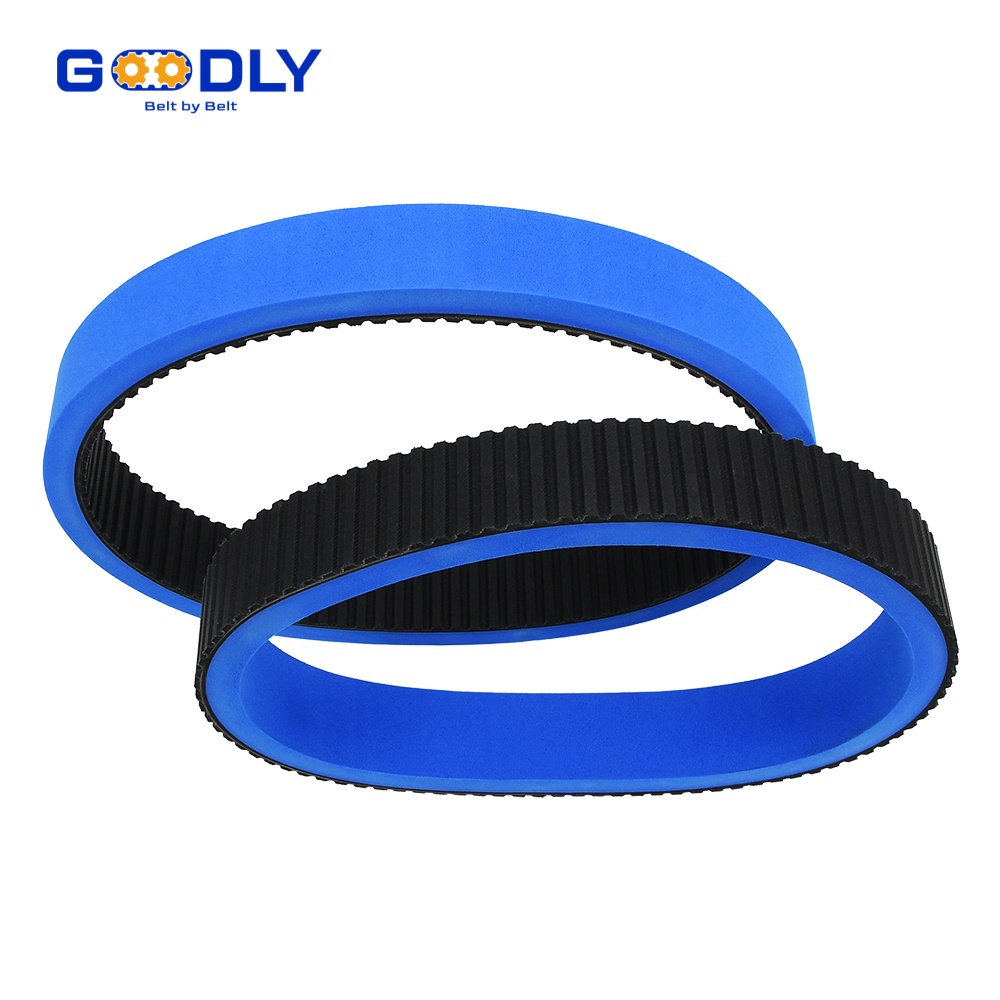
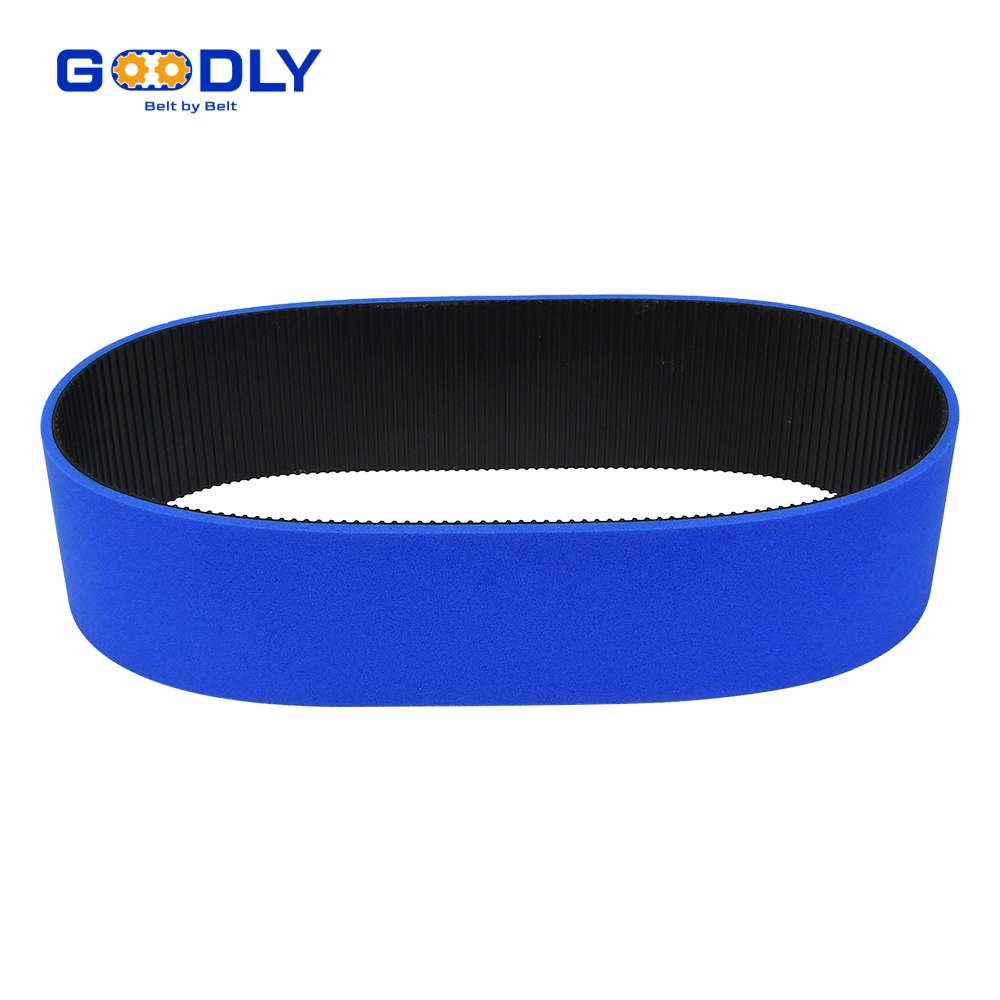
| White/blue food-grade rubber | -20 to +80 C | High friction, detectable color, FDA compounds | HFFS infeed, carton conveying, product contact |
| Silicone backing | -60 to +200 C | Heat and oil resistance, release properties, food contact | Sealing stations, hot product, coffee and snacks |
| PU / sponge foam | -20 to +80 C | Gentle grip on delicate packaging, compressible | Pouch and carton handling, egg and dairy packs |
| Plain PU or rubber (no contact) | Per construction | Economical, long life, standard profiles | Drive-only positions away from product |
Two rules keep food plants out of trouble. First, match the backing to the hottest point of the path, not the ambient — a belt that passes a sealing jaw sees that temperature every cycle. Second, prefer detectable (blue) compounds where a torn fragment must be spotted; for the gentler handling variants, our sponge and foam-coated belts are the usual choice.
Solving Packaging Line Downtime with the Right Timing Belt Supplier
Belt failures on packaging lines are rarely mysterious: ratcheted teeth from under-specifying torque, cracked backings from heat exposure, glazed friction faces from the wrong compound. The expensive part is not the belt — it is the wait. Downtime economics change what you should ask of a timing belt supplier:
- Identification speed. Can the supplier identify a worn unmarked belt from photos and pitch measurements, and confirm the profile family the same day?
- Custom length turnaround. Packaging pitches are rarely catalog sizes; a supplier that vulcanizes custom lengths from open stock in days beats one that waits for moulds.
- Coating consistency. Backing thickness and hardness batch-to-batch decides whether the machine re-tunes identically after a belt change.
- Emergency spares. Critical stations deserve a documented belt list and a standing stock agreement.
Most packaging downtime traced to belts disappears with two moves: standardizing profiles across the line (our tooth profile guide explains the families) and holding one or two custom-length spares per critical station.
GOODLY Timing Belt Solutions for Packaging Industry Equipment
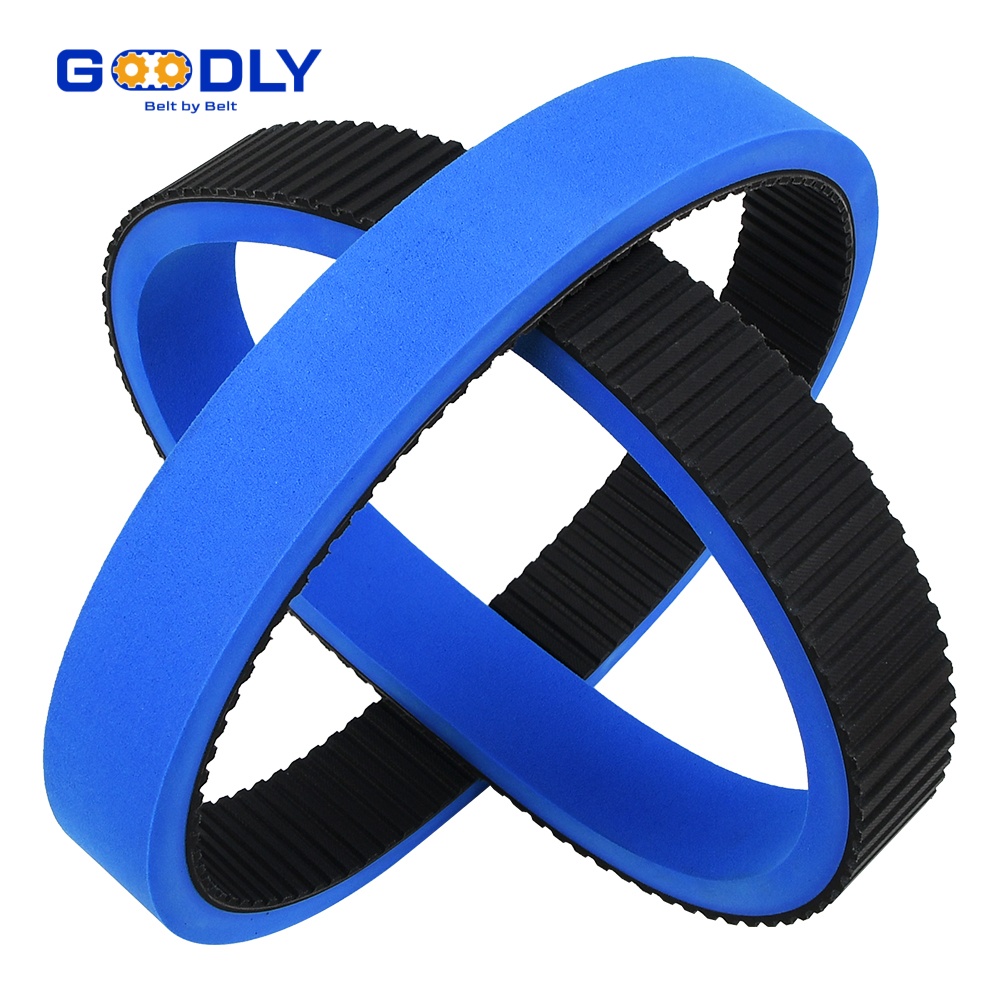
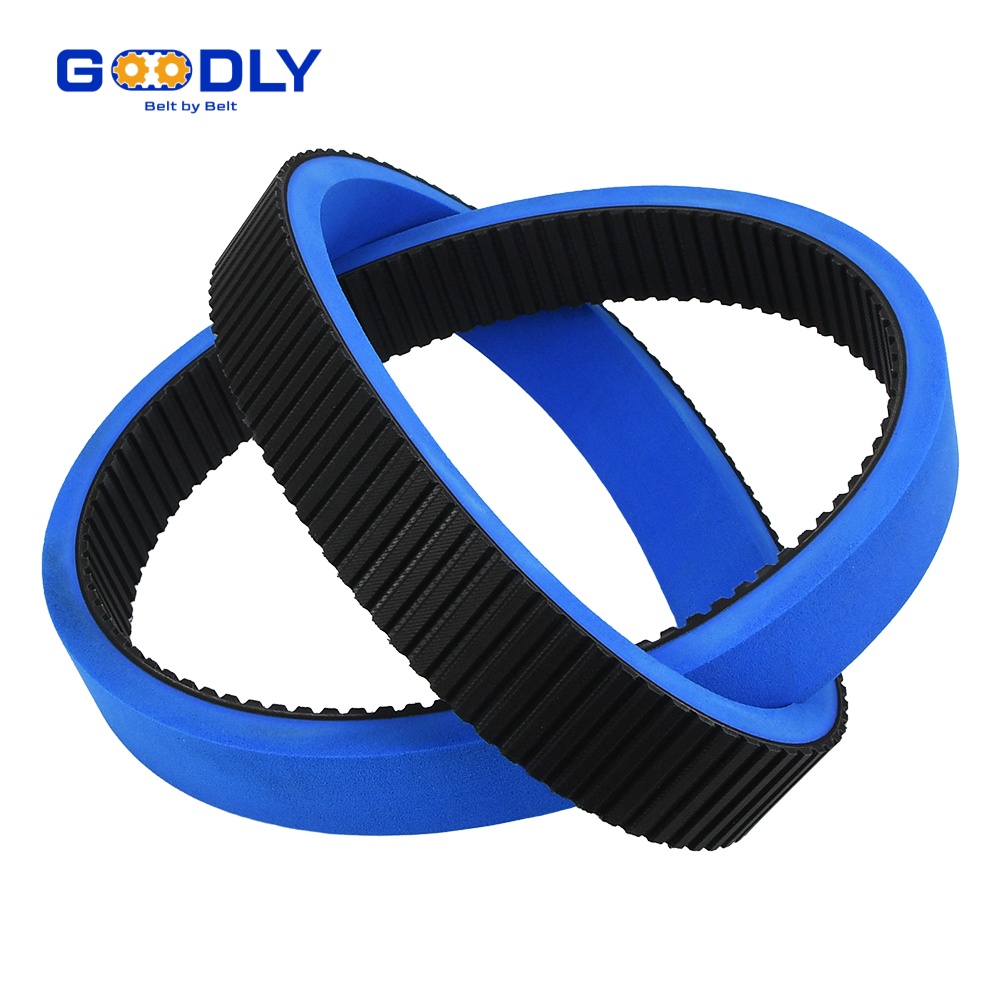
GOODLY supplies packaging OEMs and line builders with the full application menu under one roof: moulded and vulcanized timing belts, rubber, silicone and sponge backings, machined profiles, vacuum holes and cleats, plus matching pulleys. Our packaging industry page collects the machine-type solutions; the short version of how we work:
48 h engineering reply
Send a drawing, sample or station description; get a spec proposal within two working days.
3-5 day samples
Custom lengths and coated belts sampled fast, so line trials do not wait.
Food-contact compounds
FDA-compliant rubber and silicone backings, detectable blue options, full batch traceability.
OEM volumes
Stable series production with batch-to-batch consistency for machine builders.
For the complete solution map by machine type, visit our packaging industry transmission belt solutions page. For the custom specification workflow behind chocolate, coffee and other demanding products, start with custom timing belts.
What timing belt profile is most common in packaging machinery?
HTD 3M, 5M and 8M curvilinear profiles dominate modern packaging equipment because they run quietly at high speed and carry the torque headroom for indexing stations. Older European machines often still run T5 or AT10 trapezoidal belts.
Are rubber coated timing belts food safe?
They can be. Standard rubber coatings are for general product handling; for food contact, specify FDA-compliant white or detectable blue compounds. Silicone backings are the choice where belts pass sealing jaws or touch hot product.
How often should packaging machine timing belts be replaced?
Preventively, at the interval your machine builder specifies — commonly 6-12 months for product-contact belts and 12-24 months for drive-only positions. Replace immediately if you see tooth root cracking, backing glazing or registration drift.
Can timing belts handle sticky products like chocolate or adhesives?
Yes, with the right backing: harder rubber compounds with release properties, or silicone where heat is also present. Surface texture can be tuned to prevent buildup; tell us the product and we will match the compound.
Specifying Belts for a Packaging Machine?
Send GOODLY your machine type, station speeds and belt samples. We identify, specify and quote within 48 hours, ship custom samples in 3-5 days, and support OEM volume production with food-contact compliant materials.
Talk to a Timing Belt Engineer