Timing Belt Tooth Profiles and Pitches: HTD, GT2, T5, XL and AT10 Explained
Timing Belt Tooth Profiles and Pitches: HTD, GT2, T5, XL and AT10 Explained
How synchronous timing belt pitch and tooth geometry decide torque capacity, accuracy and drive life
Two synchronous timing belts with the same width can differ by a factor of three in torque capacity — and the reason is written in their teeth. The timing belt tooth profile (trapezoidal or curvilinear) and the timing belt pitch (the distance between tooth centres) decide how smoothly the belt meshes, how much torque it carries, how precisely it positions, and whether it screams or purrs at speed. Yet profile names — HTD, GT2, T5, AT10, XL — are scattered across metric and imperial systems, and mixing families is the single most common sizing mistake we see from OEMs. This guide decodes every major profile, explains HTD timing belts 8mm and other metric pitches, and shows which family to standardize on.
Timing Belt Pitch and Tooth Profile: Why Matching Pulleys Matters
Timing belt pitch is the centre-to-centre distance between adjacent teeth, measured along the pitch line of the tension cords. It is the master dimension of every timing belt system: pulley groove pitch, belt tooth pitch and centre distance all derive from it. The timing belt tooth profile is the shape of the tooth flank — classically trapezoidal (T and XL families) or curvilinear (HTD, GT and AT families), which rounds the flank to spread load away from the tooth tip.
The rules that follow from this are strict, and breaking them is expensive:
- Belt and pulley must share both pitch and profile. A T5 belt will not mesh with an AT5 pulley even though both are 5 mm pitch; flank geometry differs, so the belt rides high, wears fast and can jump.
- Wrong pitch means catastrophic ratcheting. Even a 0.5 mm cumulative mismatch forces teeth to climb out of the grooves under load — skipped teeth, crushed tooth roots, and a drive that fails within days.
- Profile decides torque character. Trapezoidal profiles locate the belt precisely and suit light-to-medium synchronous drives; curvilinear profiles carry 1.5-3× more torque at the same pitch because the rounded flank distributes stress.
- Cord line, not outer surface, defines pitch length. Specifying outside length instead of pitch length is the second most common ordering error — see our timing belt product family for how to read size codes correctly.
HTD Timing Belt Profiles: Curvilinear Teeth for High Torque Drives
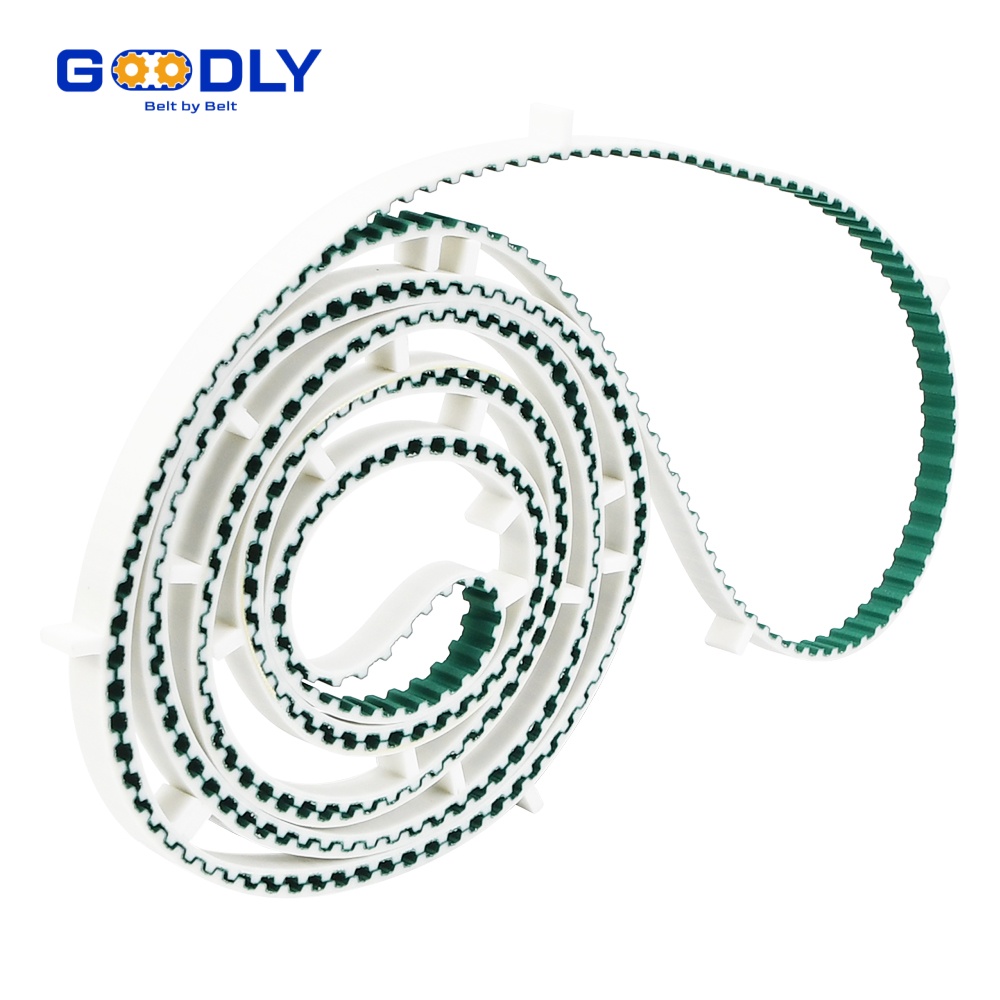
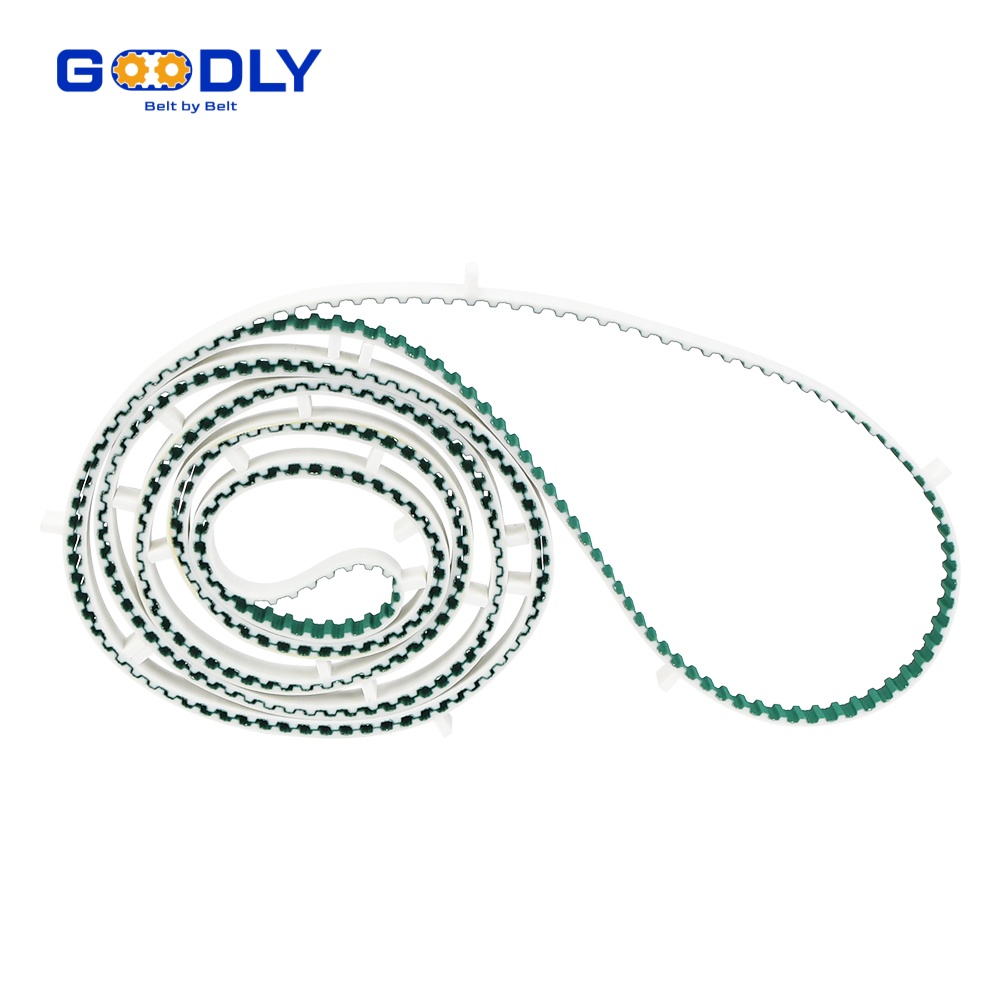
The HTD timing belt (High Torque Drive) is the industrial workhorse of curvilinear profiles. Its semicircular teeth, developed to fix the stress concentration at trapezoidal tooth roots, let the belt carry substantially higher torque in the same width and run quieter at speed. HTD timing belts dominate packaging machinery, machine tools, power transmission spares and any drive where a trapezoidal belt has ratcheted under peak load. GOODLY moulds HTD profiles in both rubber and polyurethane construction, endless or open-ended.
HTD Timing Belts 8mm and Metric HTD Timing Belt Pitch Options
HTD is specified as HTD-xM, where x is the metric pitch in millimetres. Choosing among them is mostly about torque per width and minimum pulley size:
| Profile | Pitch | Typical duty | Min pulley | Common use |
|---|---|---|---|---|
| HTD 2M / 3M | 2 / 3 mm | Light, compact | Small | Office equipment, small conveyors, robotics |
| HTD 5M | 5 mm | Light-medium | Small | Packaging machines, lab automation, pumps |
| HTD 8M | 8 mm | Medium-heavy | Medium | Machine tools, wood/metal conveying, mixers |
| HTD 14M | 14 mm | Heavy duty | Large | Heavy conveyors, crushers, large drives |
HTD timing belts 8mm (HTD 8M) are the most quoted industrial pitch: they balance real torque capacity with reasonable pulley diameters, so they suit retrofitting older drives too. A useful rule: step up one pitch size when torque exceeds roughly 5 Nm per 10 mm of width at the lower pitch. For drives that also carry product or need coatings, our timing belts with special machining pair HTD teeth with rubber, sponge or PU backings.
GT2 Timing Belt: The Precision Standard for Automation and 3D Printers
The GT2 timing belt is a 2 mm-pitch curvilinear profile with a deeper, rounder tooth than original HTD 2M — redesigned so the belt holds position under repeated direction changes instead of climbing the tooth flank. That is exactly what positioning axes do thousands of times per hour, which is why the gt2 timing belt became the de facto standard for 3D printers, CNC gantries, pick-and-place machines and linear modules.
Backlash control
Rounded flanks keep the belt seated, holding repeatability on reversing axes.
2 mm pitch
Fine resolution and small pulleys fit compact gantry layouts.
Glass or steel cords
Glass for standard duty; steel cords minimise stretch on long spans.
3-10 mm widths
From 6 mm printer axes to 10 mm+ industrial carriages.
When specifying a gt2 timing belts system, remember GT2 pairs only with GT2 pulleys — an HTD 2M pulley looks similar but its shallower groove lets the belt ride up and lose position. For multi-axis machines that need drives on both faces, we also mould GT2 construction as a double-sided belt.
T5, XL and AT10 Timing Belt Profiles for European and Imperial Machines
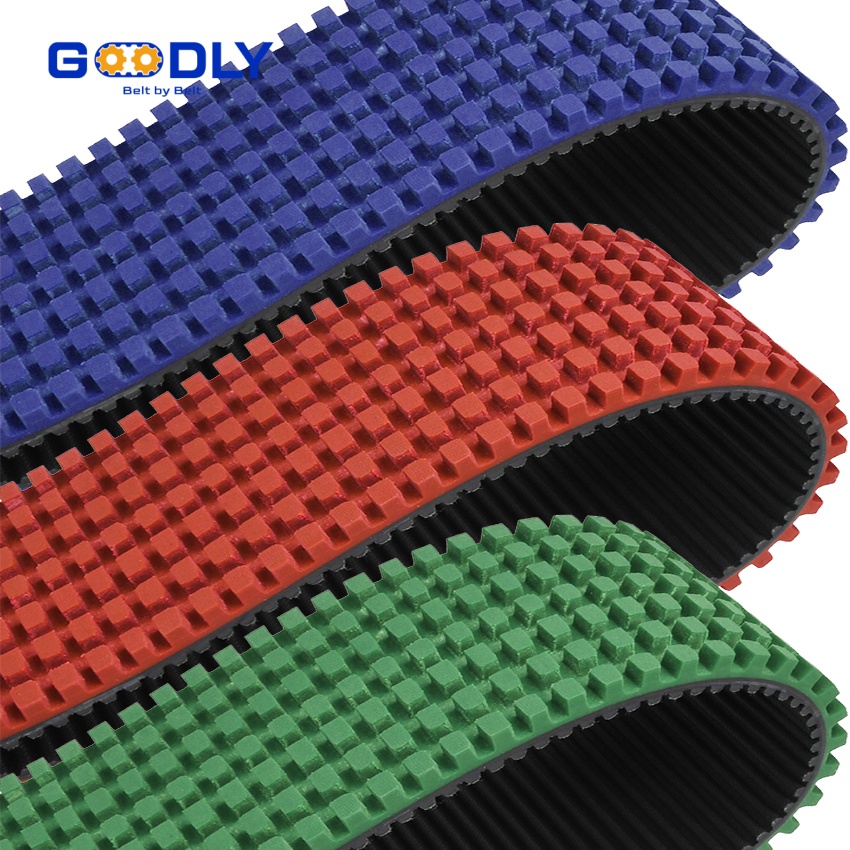
Trapezoidal families still run much of the installed machine base, and knowing their logic makes spares sourcing painless. The T5 timing belt is the European metric trapezoidal standard: 5 mm pitch, precise indexing, economical — but its flat flanks concentrate stress, so it suits medium torque. The AT10 timing belt is its modernised sibling: same 10 mm-pitch metric logic but with a steeper, stronger tooth that carries markedly higher power and resists ratcheting, making it the go-to for industrial conveying and machine tool auxiliary drives. The XL series timing belt pulleys and belts belong to the American imperial family (XL = extra light, 0.375 in pitch), still widespread on US-built and legacy equipment.
| Profile | System | Pitch | Tooth form | Best for |
|---|---|---|---|---|
| T5 | Metric, ISO 5296 style | 5 mm | Trapezoidal | Precise light-medium synchronous drives, office/medical equipment |
| AT10 | Metric, DIN 7721 | 10 mm | Modified trapezoidal | Higher-power conveying, machine tools, wood industry |
| XL | Imperial (inch) | 0.375 in | Trapezoidal | US machine base, legacy spares, light power drives |
Practical note for buyers: when a customer sends us a worn belt with no marking, the pitch measurement plus a photo of the tooth flank is usually enough for us to identify the family — T-series teeth are flat-topped trapezoids, AT teeth are steeper trapezoids, HTD/GT teeth are rounded. If you are unsure which you have, our timing belt fundamentals guide covers the measurement basics.
Which Timing Belt Profile Should You Standardize On?
Standardizing one or two profile families across a machine platform cuts spare-part inventory, pulley stock and assembly errors. Our recommendation, based on what we mould and what customers reorder:
| Application | Recommended profile | Why |
|---|---|---|
| 3D printers / light robotics | GT2 | Positioning accuracy, reversing axes, small pulleys |
| Packaging & food machinery | HTD 5M / 8M + coating | Torque headroom, quiet running, hygienic backings |
| Machine tools & wood/metal | HTD 8M or AT10 | High torque, shock resistance |
| Heavy conveying | HTD 14M | Maximum torque per width |
| US legacy machines | XL / L imperial | Matches installed pulleys without re-engineering |
Material choice interacts with profile too — a curvilinear PU belt with steel cords behaves very differently from a rubber HTD with glass cords. Our materials comparison breaks down that decision.
Let GOODLY Match the Right Tooth Profile to Your Application
Send GOODLY your drive data — shaft speeds, torque, centre distance, environment — or simply a photo of the belt you currently run, and our engineers will identify the profile, confirm the correct timing belt pitch, and quote a matching belt and pulley set within 48 hours. Every loop is checked for pitch accuracy before shipping, and samples ship in 3-5 days.
Can I use an HTD belt on a GT2 pulley, or vice versa?
No. Although GT2 evolved from HTD 2M, the tooth depth and flank curvature differ. Mixing them causes the belt to ride in the groove root or climb the flank, losing position accuracy and wearing prematurely.
Which is better, AT10 or HTD 8M?
Both carry similar torque at similar pitch. AT10 (DIN 7721) is common on European machine tools and accepts metric replacements easily; HTD 8M is the global industrial standard with the widest pulley availability. Choose by installed pulleys, and standardize there.
What does the M mean in HTD 8M?
It is the metric pitch in millimetres — 8 mm between tooth centres. The same logic applies across HTD 2M to 14M and metric AT/T families.
How do I identify the profile of an unmarked belt?
Measure the pitch between 10 teeth (divide by 10), then photograph the tooth flank. Flat trapezoid means T/XL/AT family; rounded flank means HTD/GT family. Our engineers can confirm from photos within one working day.
Not Sure Which Profile Your Drive Uses?
Send a belt photo or your drive parameters to GOODLY. We identify the tooth profile and pitch, quote belt and pulleys within 48 hours, and ship samples in 3-5 days — backed by pitch inspection on every loop.
Get a Free Profile Identification