Timing Belt Sizes and Dimensions: How to Read Specs, Codes and Size Charts
Timing Belt Sizes and Dimensions: How to Read Specs, Codes and Size Charts
Pitch length, width, tooth count and part number codes — decoded so your next order is right the first time
Most timing belt complaints do not start in the drive — they start at the order desk. A belt ordered by outside length instead of pitch length, or a code copied without its profile prefix, arrives 3% long or two teeth short and eats a week of downtime. The good news: timing belt sizes follow a small set of rules, and once you can read a timing belt size chart and decode a part number, you can order confidently for any machine. This guide explains the three core dimensions, walks through real code examples, covers timing belt calculator basics, and shows how to measure a worn or unmarked belt step by step.
Timing Belt Sizes Explained: Pitch Length, Width and Number of Teeth
Every timing belt specification reduces to three dimensions. Pitch length (Lp) is the circumference measured at the pitch line of the tension cords — the effective working length the drive geometry sees. Outside length (Lo) is the physical circumference around the tooth tips, and it is always larger than pitch length (by roughly 0.25-0.5 mm per tooth depending on profile). Width is the belt’s axial dimension, quoted in mm for metric belts and inches for imperial ones. Tie these together and you get the tooth count, since teeth = pitch length ÷ pitch.
- Order by pitch length, not outside length. Catalogs list pitch length for metric belts (e.g. a “1200-8M” is 1200 mm at the cord line, not at the tips).
- More teeth = longer life per pass. A belt needs at least 6 teeth in mesh with the small pulley; below that, load per tooth spikes and tooth shear follows.
- Width scales capacity linearly. Torque capacity is roughly proportional to width, so moving 25 mm → 30 mm buys ~20% headroom without changing the drive layout.
- Profile and pitch come first. None of the above matters unless the tooth profile matches your pulleys — see our tooth profile guide for the HTD/GT2/T/AT/XL families.
How to Read a Timing Belt Size Chart and Part Number Codes
A timing belt size chart is just a filtered list of the three dimensions, and most manufacturer codes follow one of a few patterns. Reading them is mechanical once you know the separators:
| Code on belt | How to read it | Dimensions |
|---|---|---|
| 1200-8M-30 | Pitch length - profile/pitch - width | 1200 mm Lp, HTD 8M (8 mm pitch), 30 mm wide |
| 150-S8M-525 | US style: teeth - profile - pitch x width (/100) | 150 teeth, 8M, 5.25 in (~133 mm) wide |
| T5-655-16 | Profile - pitch length - width | T5 profile, 655 mm Lp, 16 mm wide |
| AT10-1250-50 | Profile - pitch length - width | AT10 profile, 1250 mm Lp, 50 mm wide |
| 360XL037 | Pitch length (/10) + profile + width (/100 in) | 36.0 in Lp, XL profile, 0.37 in wide |
| 450-5M-25 | Pitch length - profile - width | 450 mm Lp, HTD 5M, 25 mm wide |
Two traps worth repeating. First, some brands print outside length on legacy rubber belts while quoting pitch length in catalogs — always confirm which system the number refers to. Second, imperial width codes divide by 100: “037” means 0.37 inch, not 37 mm. When a code is ambiguous, count the teeth and measure pitch yourself, then rebuild the specification from first principles using the table above.
Timing Belt Specification Sheets: What Design Engineers Must Verify
A complete timing belt specification sheet — the one you should attach to every OEM drawing or purchase order — carries six fields. Verify all of them before sign-off:
- Tooth profile and pitch (e.g. HTD 8M, GT2, AT10) — the compatibility anchor.
- Pitch length or tooth count — state one and the other follows; quoting both invites contradictions.
- Width, in the same unit system as the pulleys.
- Cord type — glass (standard), aramid (shock), steel (minimum stretch, long spans).
- Construction — endless, open-ended or spliced; see our construction comparison.
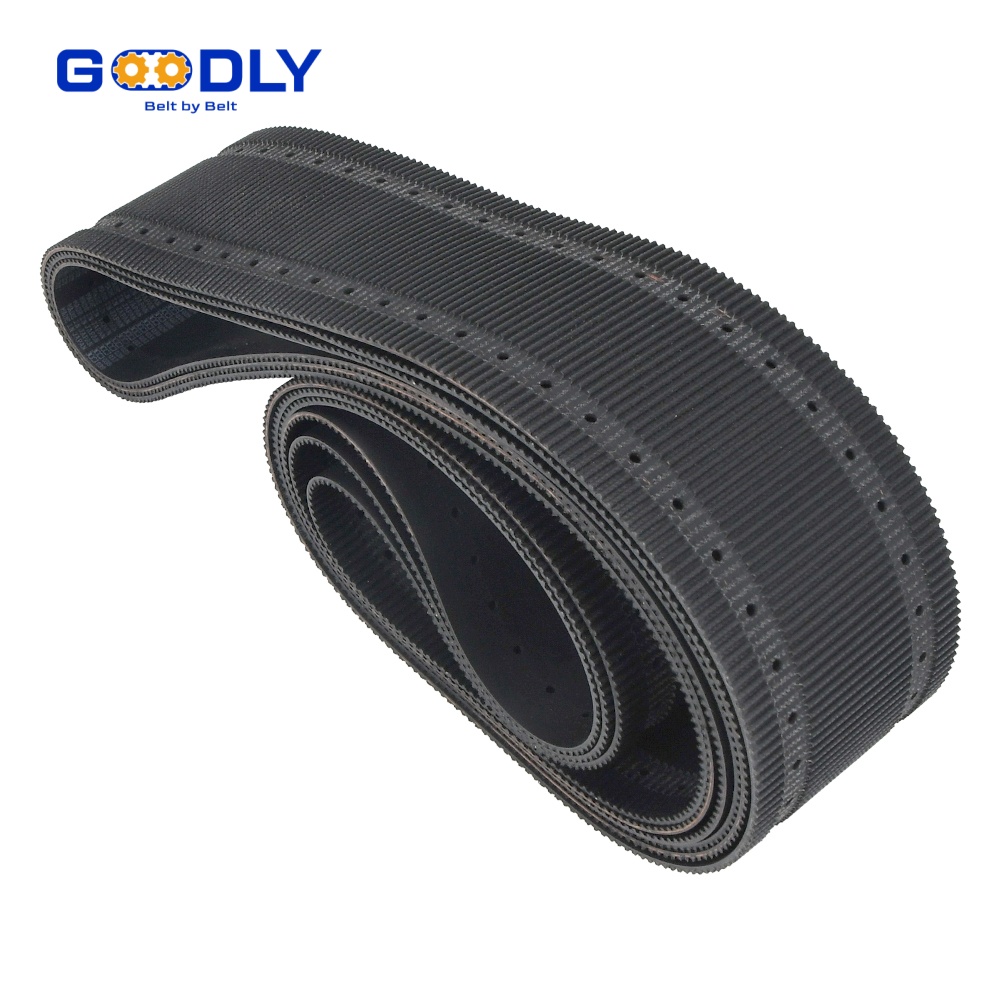
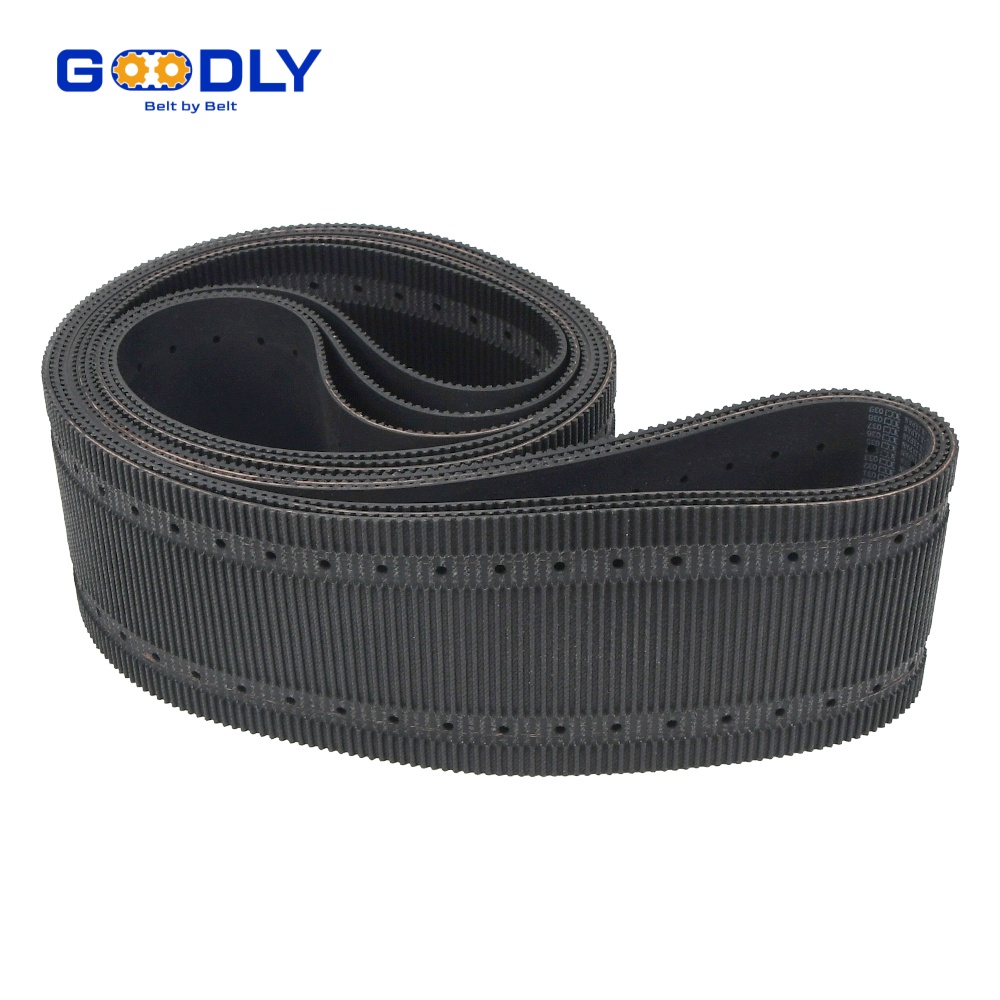
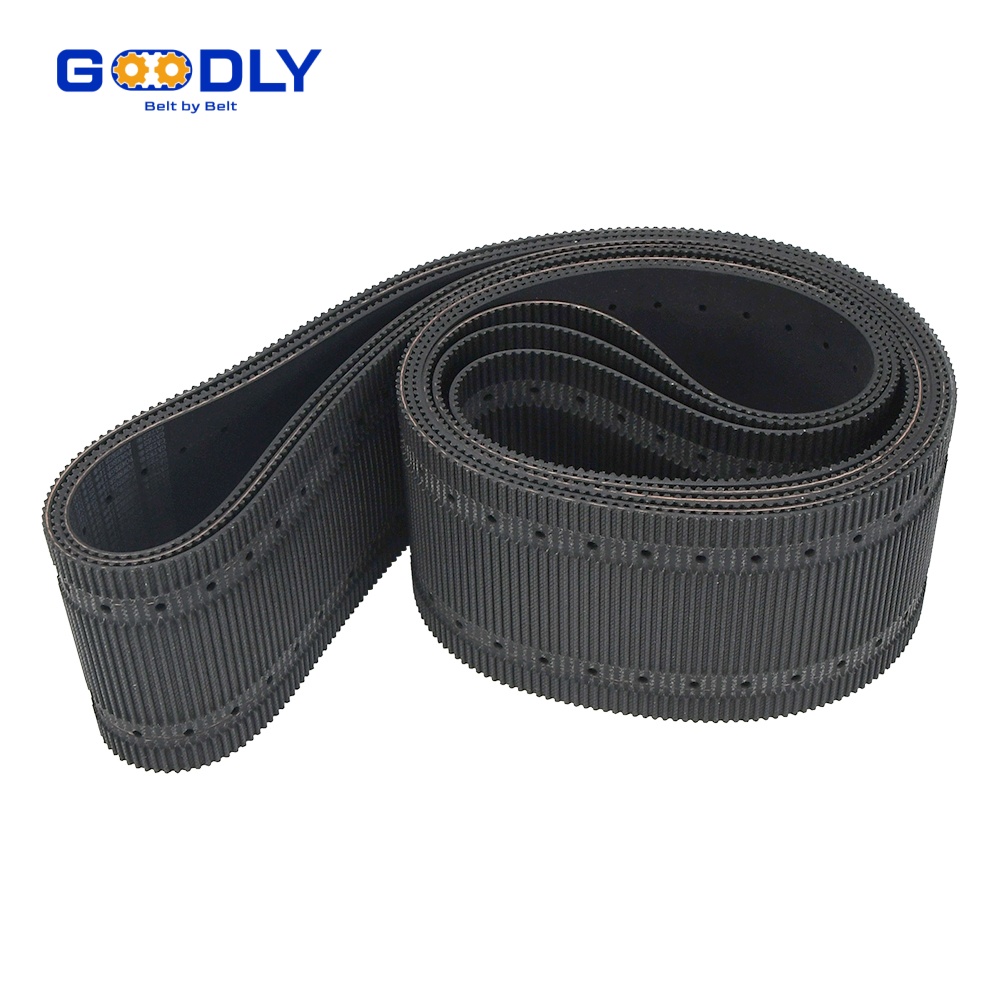
- Coating / machining — backings, cleats, guides or slots, handled on our special machining line from your drawing.
Timing Belt Calculator and Timing Belt Length Calculator Basics
When you design a drive from scratch instead of replacing an existing belt, a timing belt calculator or timing belt length calculator estimates the pitch length from pulley diameters and centre distance. The maths behind every online timing belt size calculator is one formula plus a correction:
- Start with the approximate length: L ≈ 2C + 1.57(D + d), where C is centre distance and D, d are the pulley pitch diameters.
- Add the exact-terms correction: L = 2C + 1.57(D + d) + (D − d)² / (4C). For most industrial drives the correction term is small but worth including.
- Round to a real tooth count: divide L by the pitch and round to the nearest whole tooth, then multiply back — calculators that skip this step produce lengths nobody moulds.
- Re-solve centre distance for the chosen belt so you know the tensioning travel required.
- Check teeth in mesh on the small pulley (≥6) and cord type against torque.
Whatever the tool outputs, treat the result as a starting point — real drives are constrained by which standard belt lengths exist, and good practice adjusts centre distance or idler position to a mouldable size rather than forcing a non-standard loop. Our engineers run this check for you on every quote.
Measuring a Worn or Unknown Timing Belt: Step-by-Step Method
When the belt is stretched, unmarked or from a 20-year-old machine, measure it directly. Three minutes with a caliper and a flat table is enough:
- Count the teeth. Mark a tooth with chalk, then count around the loop — this is your tooth count N.
- Measure the pitch. Measure across 10 tooth centres (tip to tip works for most profiles) and divide by 10. 5 mm → T5/AT5/HTD 5M family; 8 mm → HTD 8M; 9.525 mm → XL.
- Identify the tooth shape. Photo the flank: flat trapezoid = T/AT/XL; rounded = HTD/GT family.
- Measure width with the caliper across the belt edge, in mm or inches as the machine uses.
- Compute pitch length: Lp = N × pitch. Example: 150 teeth × 5 mm = 750 mm pitch length → “750-5M”.
- Send us the numbers — or the belt itself — and we will confirm the family and quote the exact replacement.
If the belt is broken or badly stretched, measure the flat length and add the pitch-line correction, or better, measure the pulleys and centre distance and work forward from drive geometry. Either route lands on the same timing belt sizes our chart uses.
Send GOODLY Your Belt Sample or Drawing for Exact Sizing
No belt should sit in a machine unfitted because of a code nobody can read. Post us the old belt, a photo, or your drawing, and GOODLY’s engineers will measure, identify the profile, and return a full timing belt specification — profile, pitch length, width, cords, coating — with a quote within 48 hours. Samples of standard sizes ship in 3-5 days; custom loops in 10-15 days.
Is pitch length the same as outside length?
No. Pitch length runs at the cord line and is the dimension drives are designed around; outside length is measured at the tooth tips and is larger by roughly 0.25-0.5 mm per tooth. Catalogs and codes normally quote pitch length — confirm before ordering.
How many teeth in mesh do I need?
At least six on the smaller pulley. Below six, each tooth carries disproportionate load and tooth shear or ratcheting becomes likely under peak torque.
Can I order a non-standard length?
Yes. We mould custom pitch lengths in all major profiles, and open-ended PU can be cut and welded to almost any length — useful for long conveyors beyond standard moulded loops.
My belt has no markings at all. Can you still match it?
Almost always. Tooth count, pitch measurement, a flank photo and width give us the complete specification; from that we quote a direct replacement or an improved equivalent.
Send Your Old Belt — Get the Exact Spec Back
Post a sample or send photos and measurements to GOODLY. We identify profile and pitch, rebuild the full specification, and quote within 48 hours — with size verification on every belt we ship.
Get Exact Sizing Support