Inside a Timing Belt Factory: How Industrial Timing Belts Are Manufactured
Inside a Timing Belt Factory: How Industrial Timing Belts Are Manufactured
From rubber compound to finished belt: the production steps, curing control and quality gates behind a precision drive component
An industrial timing belt looks like a simple rubber loop, but it is a precision component manufactured in seven controlled stages, each of which can quietly ruin the finished part. A cord that was not pre-tensioned correctly lets the belt grow in service; a curing cycle that runs hot hardens the compound before it ever sees a pulley; a tooth profile ground a few tenths out increases noise and wear for the life of the drive. This tour through a timing belt factory explains how timing belts are manufactured, stage by stage — compounding, calendering, cord preparation, vulcanized timing belt curing, tooth machining and quality inspection — so buyers and machine builders know exactly what they are paying a timing belt manufacturer to control.
Industrial Timing Belt Manufacturing Steps: From Compound to Finished Belt
Modern industrial timing belt manufacturing is a chain of specialist processes, and each stage sets a property the following stages depend on. Skip or shortcut one and the defect only shows up months later, running on a customer's machine. The table below is the standard production route for rubber and PU timing belts in a vertically integrated timing belt factory:
| Stage | What happens | Why it matters |
|---|---|---|
| Rubber compounding | Neoprene or EPDM bases mixed with fillers, accelerators and curing agents | Sets elasticity, heat resistance and ageing behaviour of the belt body |
| Cord preparation | Fiberglass, aramid or steel cord twisted, dipped and pre-tensioned | Controls elongation, load capacity and dimensional stability |
| Calendering | Compound sheeted to controlled gauge, cord embedded or fabric coated | Gives uniform tooth body thickness and coating adhesion |
| Molding and curing | Sleeves vulcanized in ring molds under heat and pressure | Fixes tooth geometry and gives the vulcanized belt its strength |
| Tooth machining | Grinding, punching, notching, slotting and back grinding | Delivers precision timing belt tolerances and special profiles |
| Cutting and finishing | Sleeves slit to width, edges trimmed, surfaces coated or marked | Final width, running surface and traceability marking |
Rubber Compounding and Calendering in Timing Belt Production
Everything about a finished belt is decided in the first two stages. The compound determines how the belt ages; the calender line determines how consistently it is built.
- Compound design. Neoprene remains the workhorse for rubber timing belts because it balances flex fatigue, heat and oil resistance; EPDM brings better ozone and heat ageing; silicone compounds take over above roughly 200 °C; PU bodies serve clean, dry, high-precision drives.
- Cord selection and pre-tension. The cord is the skeleton. Glass cord suits most industrial drives, aramid adds shock resistance, steel carries the highest loads. Every cord is twisted and held under pre-tension so the finished belt keeps its pitch length under load.
- Calendering discipline. Rubber is sheeted onto fabric or cord at a controlled gauge, because a tooth body that varies by a few hundredths of a millimetre produces uneven tooth loading — and uneven loading is what you hear as belt noise later.
- Batch control. Compound batches are logged with cure data and retained samples, so any field issue can be traced back to a specific production week.
Vulcanized Timing Belt Curing: Molding, Pressure and Temperature Control
Curing is where a belt earns the word vulcanized. The sleeve assembly — cord, tooth rubber and backing fabric — goes into a ring mold whose inner surface carries the tooth profile in negative. Heat, pressure and time convert the soft compound into a stable elastomer, and the cycle parameters are the difference between a belt that runs for years and one that cracks in months.
- Temperature. Rubber compounds typically cure at 150-170 °C mold temperature. Under-cure leaves soft, weak teeth; over-cure hardens the compound and cuts flex life before the belt leaves the factory.
- Pressure. The mold is clamped so the compound flows into every tooth cavity and bonds to the cord line without porosity. Insufficient pressure shows up later as tooth-root voids and early cracking.
- Dwell time. Sized to the thickest section of the sleeve, not the average, so the whole cross-section reaches full cure at the same moment.
- Controlled cooldown. Sleeves cool under constraint so tooth geometry and pitch length hold as the compound sets — free cooling lets the ring distort.
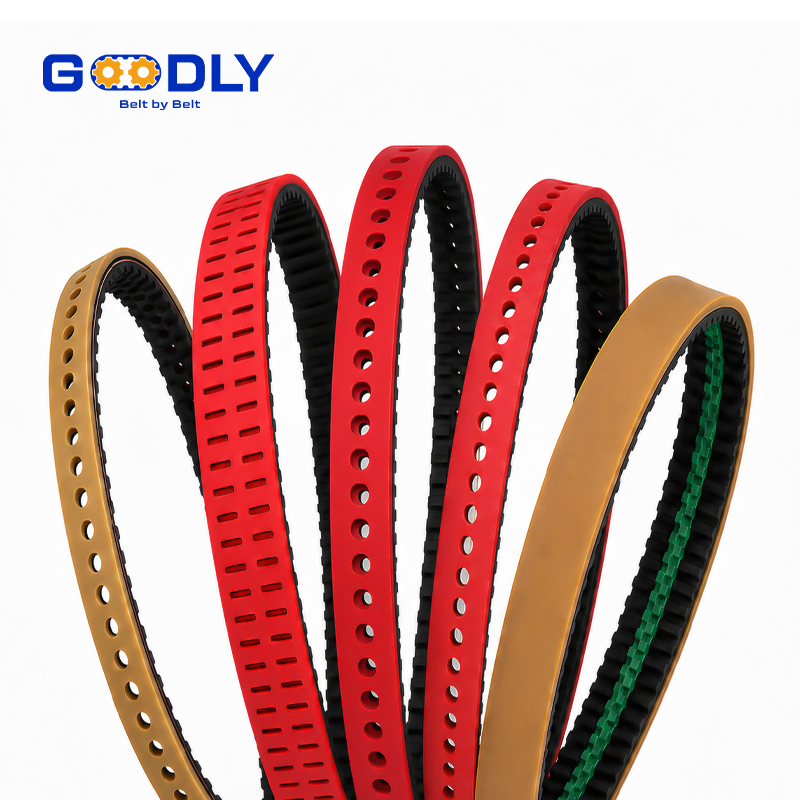
This is also the stage that separates a seamless vulcanized timing belt from cheaper joined constructions: the ring-molded sleeve has no splice, no weak point in the cord line, and a tooth profile formed rather than cut. The process is compared in detail in our vulcanized belt explained guide.
Precision Machining of Timing Belt Teeth and Profiles
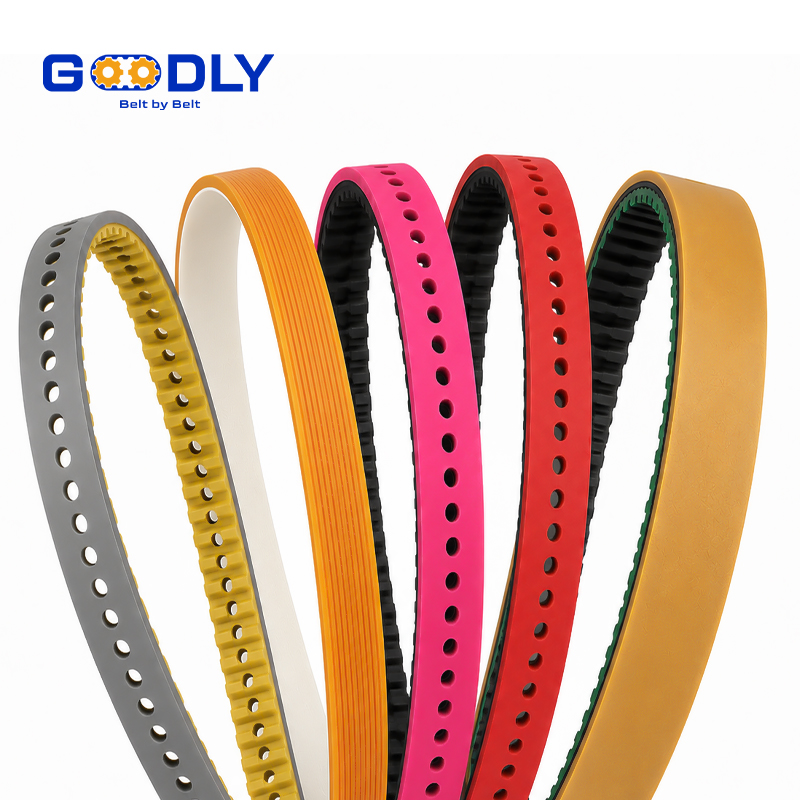
After curing, sleeves move to the machining section, where a standard sleeve becomes a precision timing belt for a specific machine. Ring sleeves are slit to width on multi-blade cutters; tooth surfaces are ground to height; and special machining adds the features that let one belt carry, register, vacuum or index as well as drive.
- Slitting to width. Multi-blade cutters split the sleeve into finished widths, holding the customer's width tolerance across the whole ring.
- Tooth grinding and back grinding. Grinding brings tooth height and backing thickness into tolerance and leaves a true-running surface for coated or friction applications.
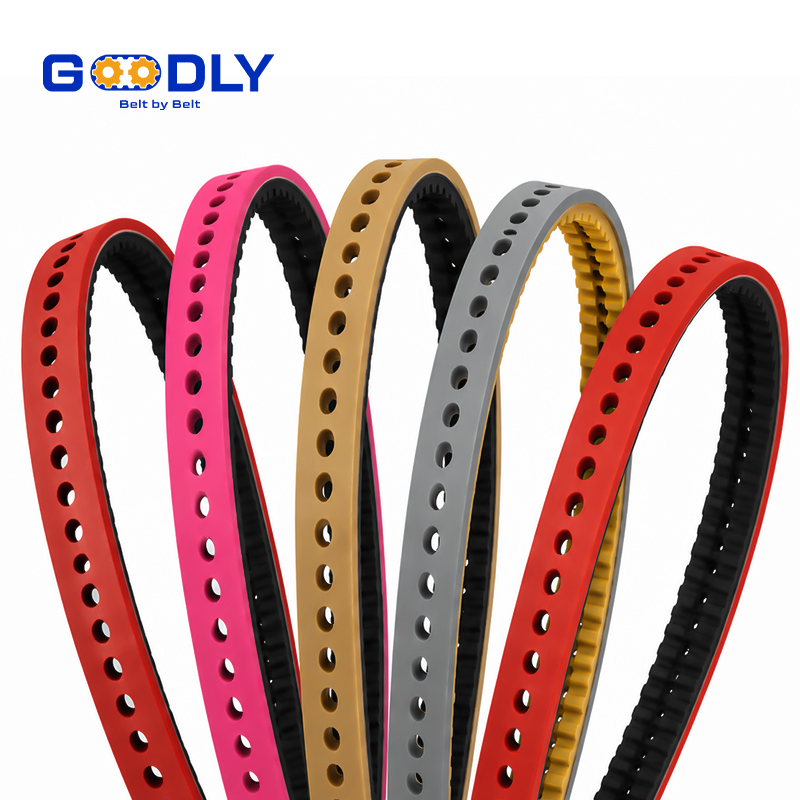
- Punching and slotting. Suction holes, positioning holes and slots are punched for vacuum conveying, indexing and registration stations.
- Notching and profiling. Custom tooth modifications, ramps and cleat seats are machined for feeding and product-transfer applications.
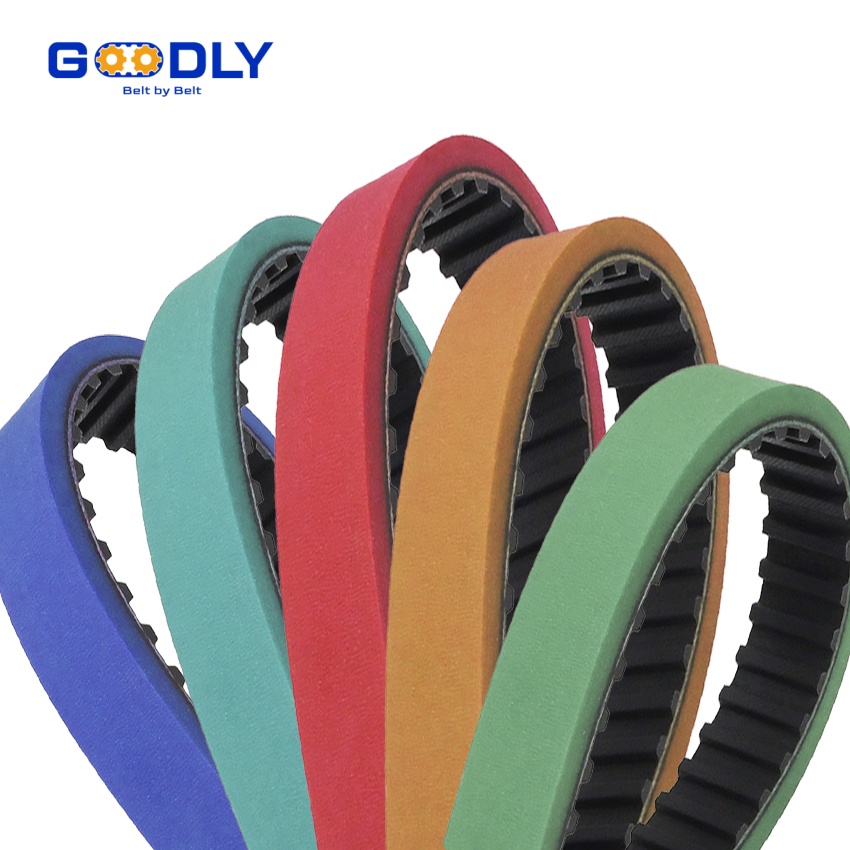
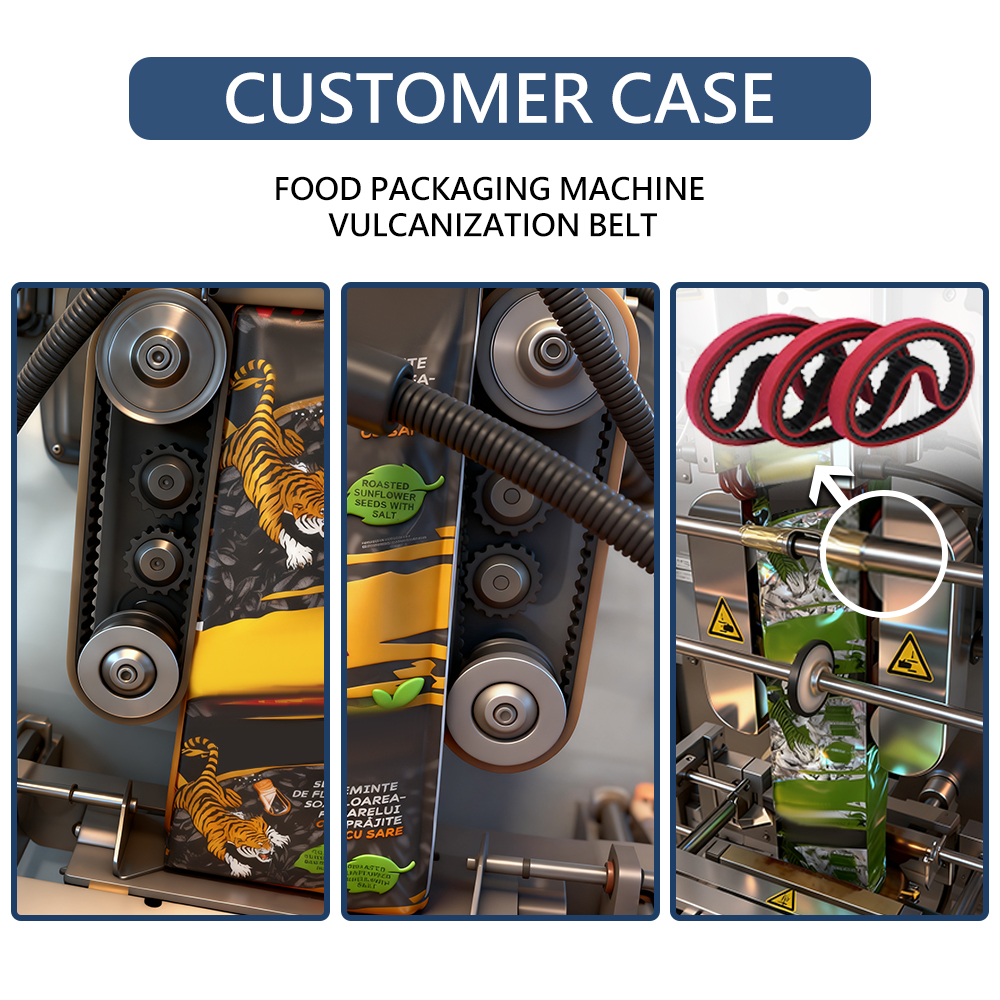
- Coating and covering. Rubber, PU foam or fabric faces are vulcanized or bonded on where the belt doubles as a product-contact surface — the same plant covers sponge, rubber-coated and PVC-style finishes.
- Marking for traceability. Codes moulded or printed on the back let maintenance identify pitch, width and construction without measuring.
Quality Gates in Timing Belt Factories: Inspection and Tension Testing
A serious timing belt factory does not inspect belts at the end; it inspects at gates, so a defect is caught in the stage that created it. The comparison below shows the typical gates and what each one is actually there to catch:
| Quality gate | Method | What it catches |
|---|---|---|
| Incoming compound | Rheometer cure curves, hardness and density checks | Bad compound batches before they enter production |
| Calender output | Gauge scans and fabric adhesion peel tests | Thickness variation and weak rubber-to-fabric bonding |
| Post-curing | Hardness, dimension and visual checks on every sleeve | Under-cure, over-cure, porosity and tooth distortion |
| Machining | Width, tooth height and runout measurement | Slitting drift, grinding steps and out-of-tolerance profiles |
| Tension testing | Sample belts pulled on a rig to rated load | Cord slippage, elongation and splice-free strength |
| Final inspection | 100% visual and dimensional check before packing | Surface defects, marking errors and mixed labels |
What to Look for in an Industrial Timing Belt Factory Partner
For buyers, the practical question is not how the process works but which timing belt manufacturer actually controls it. Price differences between suppliers usually map directly to which stages have been outsourced or simplified. When auditing a potential partner, these are the checks that matter most:
- Vertical integration. Compounding, calendering, molding and machining in one plant means shorter development loops and batch-to-batch consistency; traders and assembly-only shops cannot control either.
- Mold capability. Ask how pitch lengths and profiles are tooled: a factory with its own ring molds can sample a custom length in days, while one dependent on outside tooling quotes weeks.
- Special machining depth. Grinding, punching, slotting and coating in-house — the capabilities listed in our custom timing belt guide — determine whether your belt leaves the factory finished or needs a third process you have to manage.
- Quality documentation. Retained samples, cure records and a written quality-gate plan are what make a complaint investigation possible at all.
- Engineering support. The best factories review your drive data before quoting, because the cheapest failure is the belt that was correctly made to the wrong specification.
- Traceable marking. Every belt should carry a code linking it back to its production record.
Tour GOODLY: Custom Industrial Timing Belt Manufacturing in China
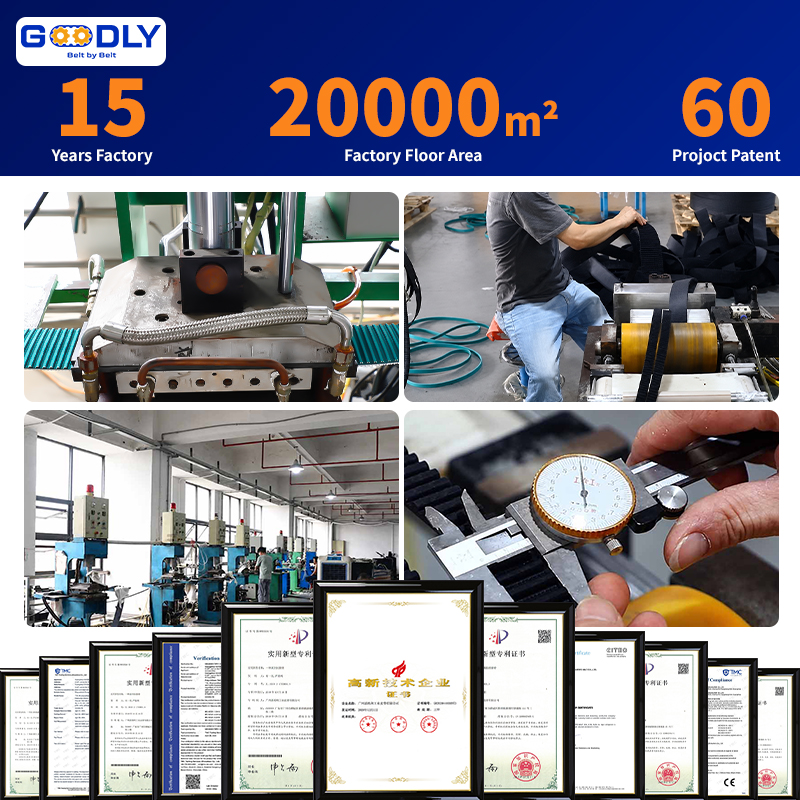
GOODLY (Guangzhou Goodly Industry Belt Co., Ltd.) has manufactured industrial timing belts for 15 years on a 20,000 m² factory floor, holding 60 project patents across timing belt, flat belt and conveyor belt product lines. The full chain — compounding, calendering, ring molding, vulcanized curing, precision machining, coating and inspection — runs in one plant, which is how custom prototypes ship in 3-5 working days and approved constructions repeat identically across production batches. Visitors are welcome: seeing the curing presses and the inspection line explains in an hour what brochures never quite convey. Company background, equipment and certifications are on our about page, and the vulcanized product line is detailed on the Vulcanized Timing Belt page.
How long does it take to manufacture a custom timing belt?
For a new custom construction, prototype sampling typically takes 3-5 working days once the drawing and compound are confirmed, because ring molding, curing and machining happen in one plant. Series production then follows the approved construction, with lead times driven by quantity rather than development.
What is the difference between molded and vulcanized timing belts?
In common industry usage, a vulcanized timing belt is ring-cured in one piece under heat and pressure, producing a seamless belt with no splice in the cord line. Molded-to-length and mechanically joined alternatives trade some strength and running smoothness for tooling flexibility. The trade-offs are compared in our vulcanized versus molded guide.
Which cord should I choose: fiberglass, aramid or steel?
Fiberglass suits most industrial drives with good flex life and dimensional stability. Aramid adds shock-load capacity for corrugated, die-cutting and heavy conveying. Steel carries the highest loads with minimal elongation but needs larger pulleys and gentler small-radius handling. Send your torque and speed data and the manufacturer should confirm the choice.
Can I visit a timing belt factory before ordering?
Yes, and it is worth doing. GOODLY welcomes customer audits and factory tours at its Guangzhou plant; walking the line from compounding to final inspection is the fastest way to judge whether a manufacturer actually controls its process. Video audits can be arranged when travel is not practical.
Planning a Custom Belt Development or a Factory Audit?
Send GOODLY your belt drawing, the belt code you are replacing, or simply a date for a factory tour. Our engineers review the specification before quoting, sample custom industrial timing belts in 3-5 working days, and stand behind every batch with retained samples and full traceability.
Contact the GOODLY Factory Team